Web Design
Web design + CRO resources by Areculateir.
Abstract: High-converting websites don’t “explain.” They diagnose and guide as one touch-point in a larger ecosystem.
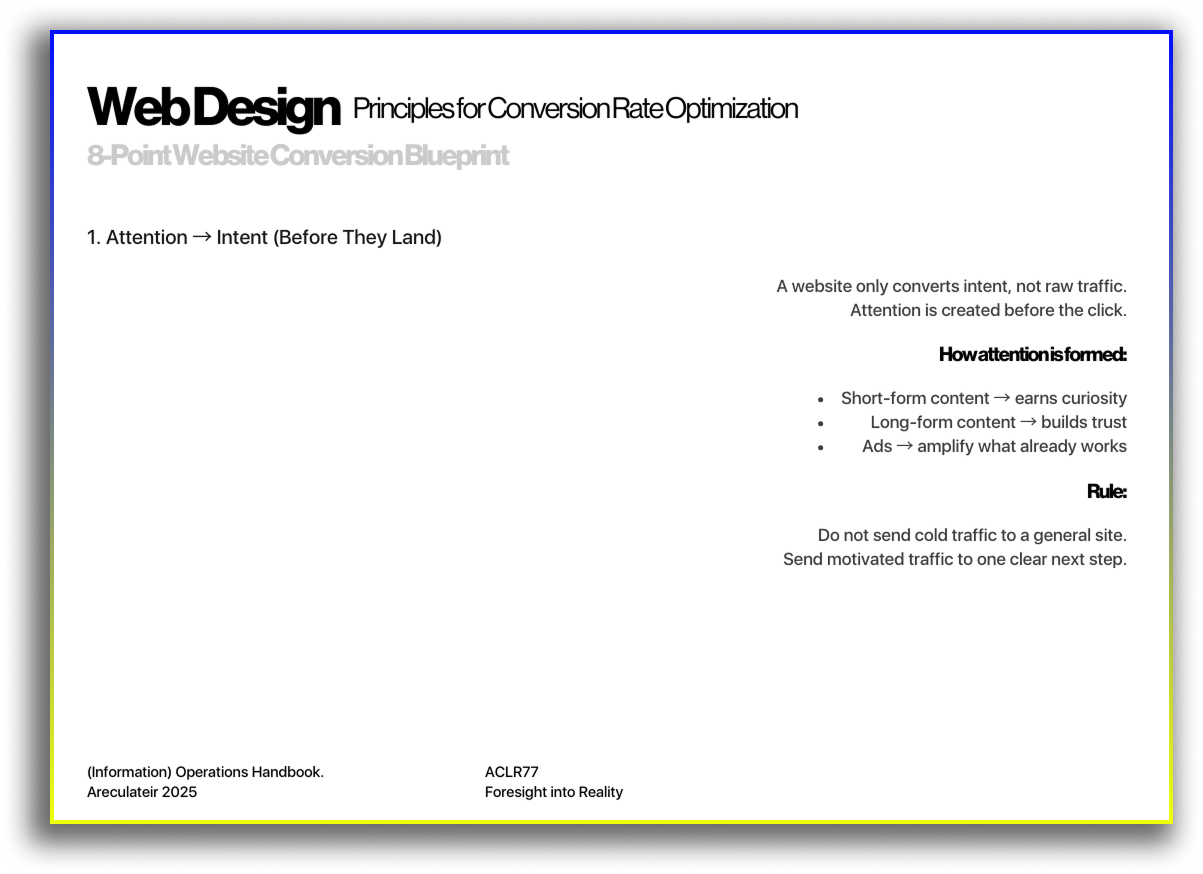
1. Attention → Intent (Before They Land)
A website only converts intent, not raw traffic. Attention is created before the click.
How attention is formed:
- Short-form content → earns curiosity
- Long-form content → builds trust
- Ads → amplify what already works
Rule:
Do not send cold traffic to a general site. Send motivated traffic to one clear next step.
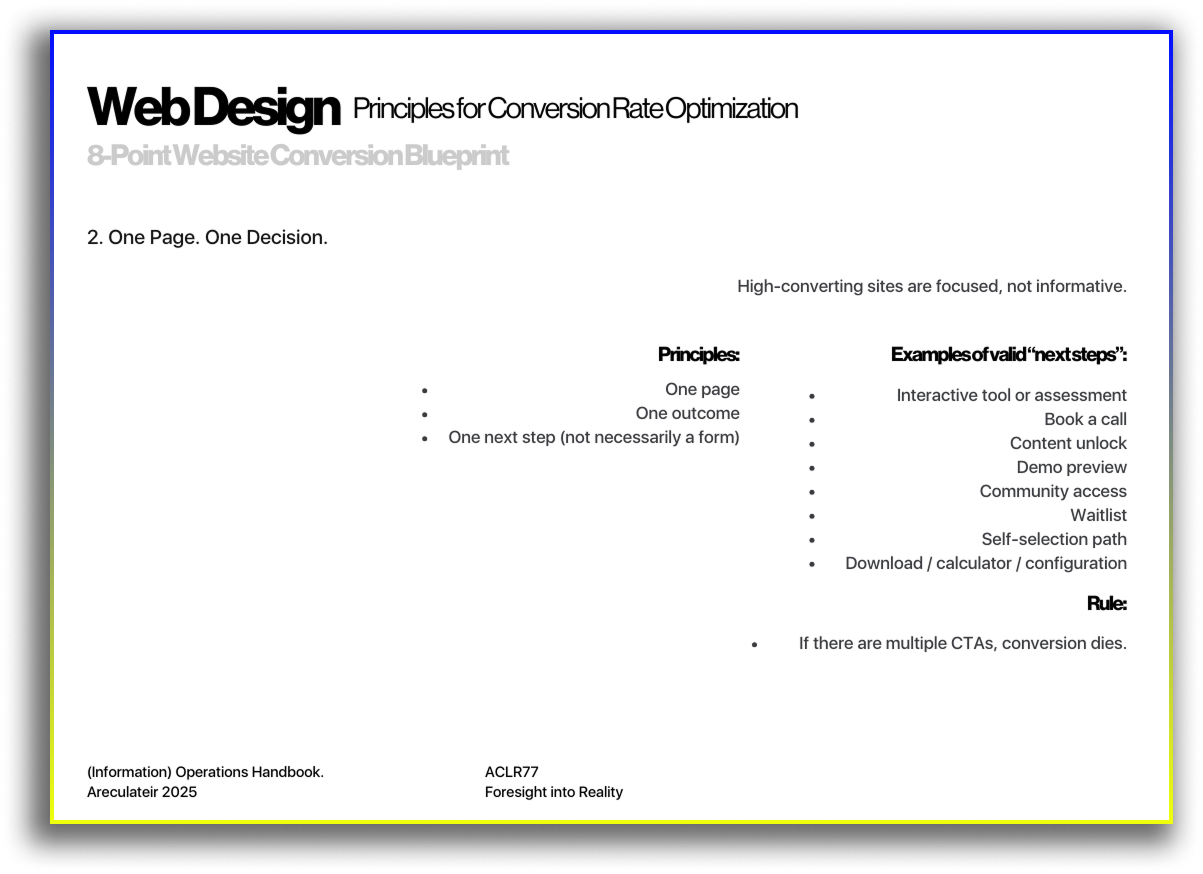
2. One Page. One Decision.
High-converting sites are focused, not informative.
Principles:
- One page
- One outcome
- One next step (not necessarily a form)
Examples of valid “next steps”:
- Interactive tool or assessment
- Book a call
- Content unlock
- Demo preview
- Community access
- Waitlist
- Self-selection path
- Download / calculator / configuration
Rule:
If there are multiple CTAs, conversion dies.
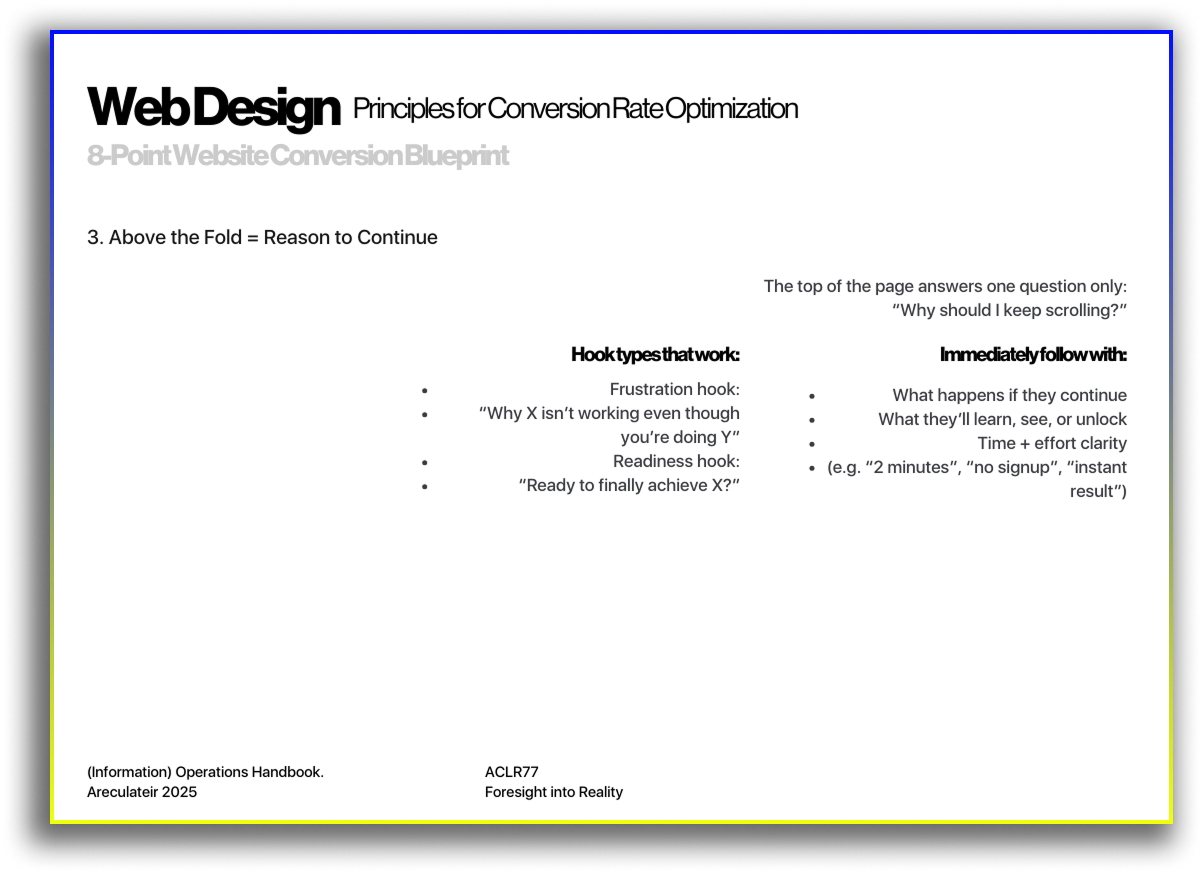
3. Above the Fold = Reason to Continue
The top of the page answers one question only: “Why should I keep scrolling?”
Hook types that work:
- Frustration hook: “Why X isn’t working even though you’re doing Y”
- Readiness hook: “Ready to finally achieve X?”
Immediately follow with:
- What happens if they continue
- What they’ll learn, see, or unlock
- Time + effort clarity (e.g. “2 minutes”, “no signup”, “instant result”)
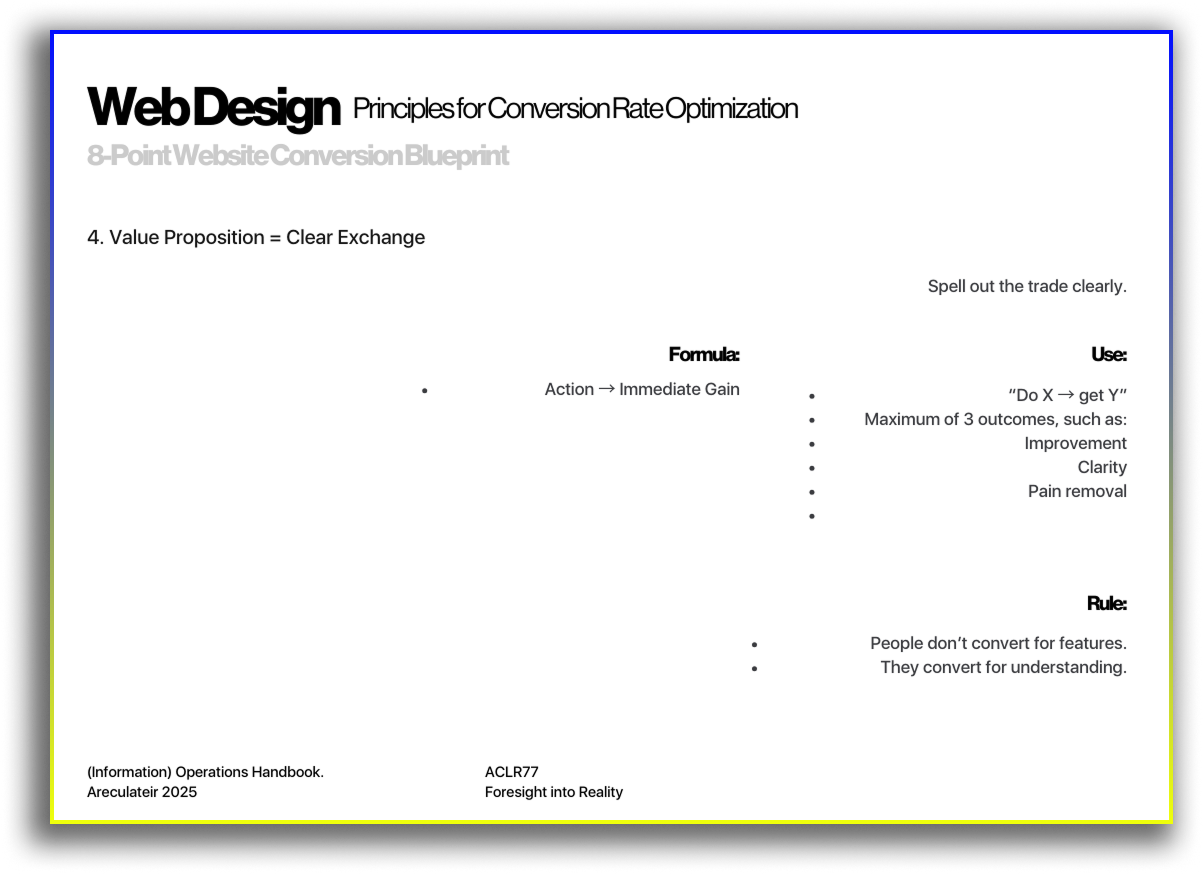
4. Value Proposition = Clear Exchange
Spell out the trade clearly.
Formula:
Action → Immediate Gain
Use:
- “Do X → get Y”
- Maximum of 3 outcomes, such as: Improvement, Clarity, Pain removal
Rule:
People don’t convert for features. They convert for understanding.
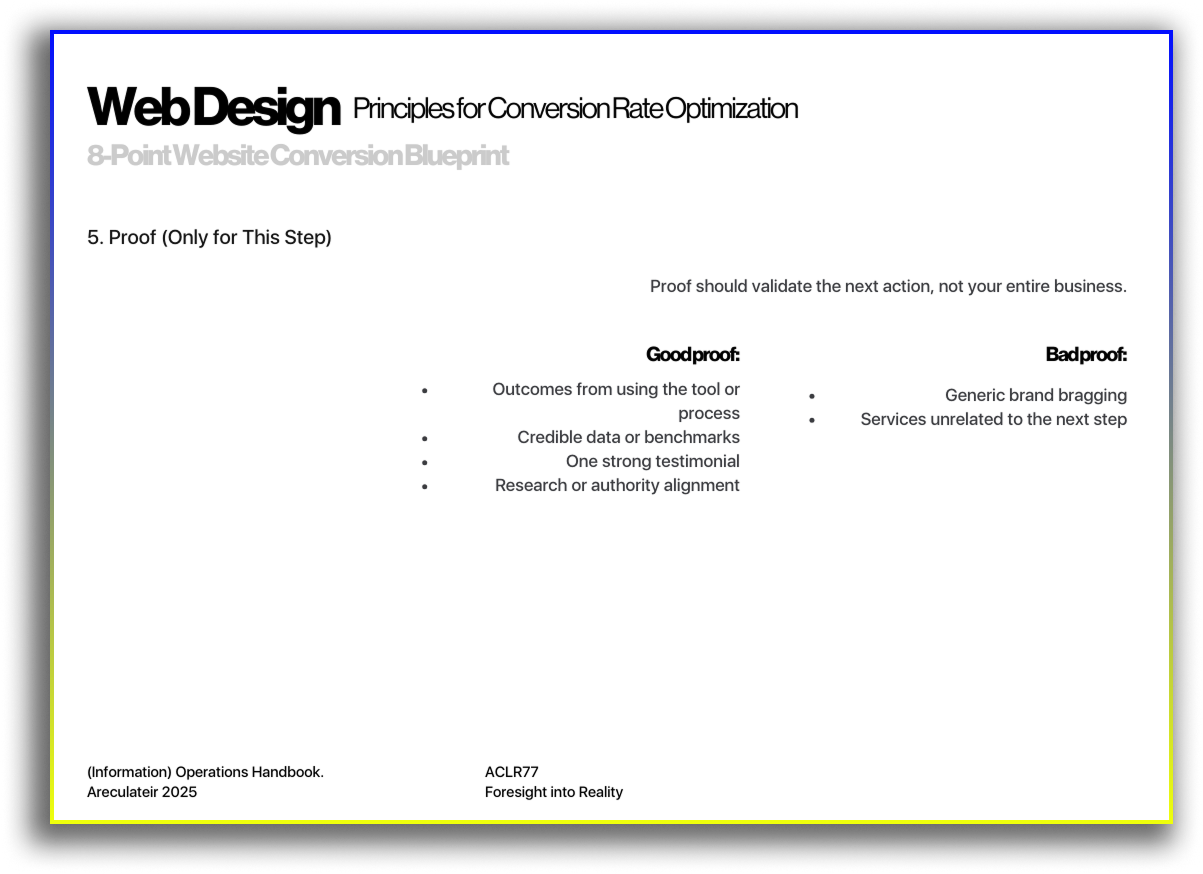
5. Proof (Only for This Step)
Proof should validate the next action, not your entire business.
Good proof:
- Outcomes from using the tool or process
- Credible data or benchmarks
- One strong testimonial
- Research or authority alignment
Bad proof:
- Generic brand bragging
- Services unrelated to the next step
6. Frictionless CTA (The No-Brainer Next Step)
Tell them exactly what happens next.
Kill resistance by clarifying:
- Cost (free / no commitment)
- Time (how long it takes)
- Effort (how hard it is)
- Outcome (what they get immediately)
Rule:
If they think “why not?” — you win.
7. Follow-Up
Conversion does not end on the page.
Follow-up channels:
- Messaging
- Content
- Sales outreach (if appropriate)
Follow-up reinforces:
- Their problem
- Their result
- Their recommended path
8. Debug by Stage (No Guesswork)
If it’s not converting, you always know where.
Diagnose precisely:
- Low traffic → attention problem
- High traffic, low action → page clarity problem
- Action, no conversion → insight or recommendation problem
Outcome:
This turns marketing from guessing into engineering.