Design Sensibilities

Famous designers & creators — core sensibilities distilled for application.

Use these as “lenses” when you’re making UI decisions: what to remove, what to emphasize, what to systematize, and what emotional tone to aim for.

Jony Ive — Reduction, Purity, Purpose

Removes anything non-essential until only the meaningful remains — without losing warmth. Minimalist, but never sterile: every curve, material, and transition feels inevitable. Engineering and tactility meet in quiet confidence: the object doesn’t “announce” design — it simply feels right through proportion, detail, and user experience.

  • Eliminate noise until the signal is undeniable
  • Obsess over proportion, spacing, and material “feel”
  • Let calm surfaces + symmetry do the talking
Wes Anderson — Hyper-Stylized, Symmetrical, Storybook Worlds

Builds nostalgic, surreal universes using meticulous symmetry, curated palettes, and analog texture. Every scene is like a diorama: centered compositions, controlled lighting, deliberate type and music. It’s not realism — it’s narrative voice: intentionally artificial, emotionally contained, instantly recognizable.

  • Commit to a palette and enforce it everywhere
  • Use symmetry and layout discipline to create “world rules”
  • Lean into texture + nostalgia to evoke emotion

Paul Rand — Bold, Rational, Timeless (Clarity Meets Play)

Treats design as problem-solving, not decoration. Modernist structure (grids, typography, geometry) paired with wit and metaphor. Simplicity isn’t style — it’s clarity. Marks should be ideas made visible: disciplined, communicative, and memorable without trying too hard.

  • Prioritize communication over aesthetics
  • Use geometric reduction to make ideas obvious
  • Add “play” only if it sharpens the message

Michael Bierut — Intelligent, Pragmatic, Culturally Fluent

Doesn’t chase a signature style — adapts to the problem with clarity and strategic purpose. Excels at systems: identities and typographic architectures that scale while staying coherent. The best design feels obvious in hindsight because it organizes meaning so well.

  • Design systems, not single screens
  • Be restrained until boldness is required by the message
  • Make structure do the heavy lifting

Paula Scher — Loud, Layered, Typographically Explosive

Treats type as image: energetic, architectural, and culturally charged. Influences pull from Constructivism, Pop Art, and street culture. Rejects minimalism when maximalism tells the story better. Typography dominates space to disrupt, declare, and define.

  • Use typography as the hero, not decoration
  • Layer hierarchy to mirror real-world energy
  • Maximalism is valid when it clarifies the vibe

Ronnie Fieg — Streetwear Credibility Meets Luxury Restraint

Elevates familiar forms through material upgrades, refined palettes, and story. Blends 90s NYC streetwear, sportswear, and hip-hop culture with premium execution. Nuance wins: tonal layering, subtle branding, and collectible-level restraint.

  • Upgrade materials + finishing before adding new shapes
  • Prefer subtle branding and tonal contrast
  • Turn nostalgia into modern collectibility

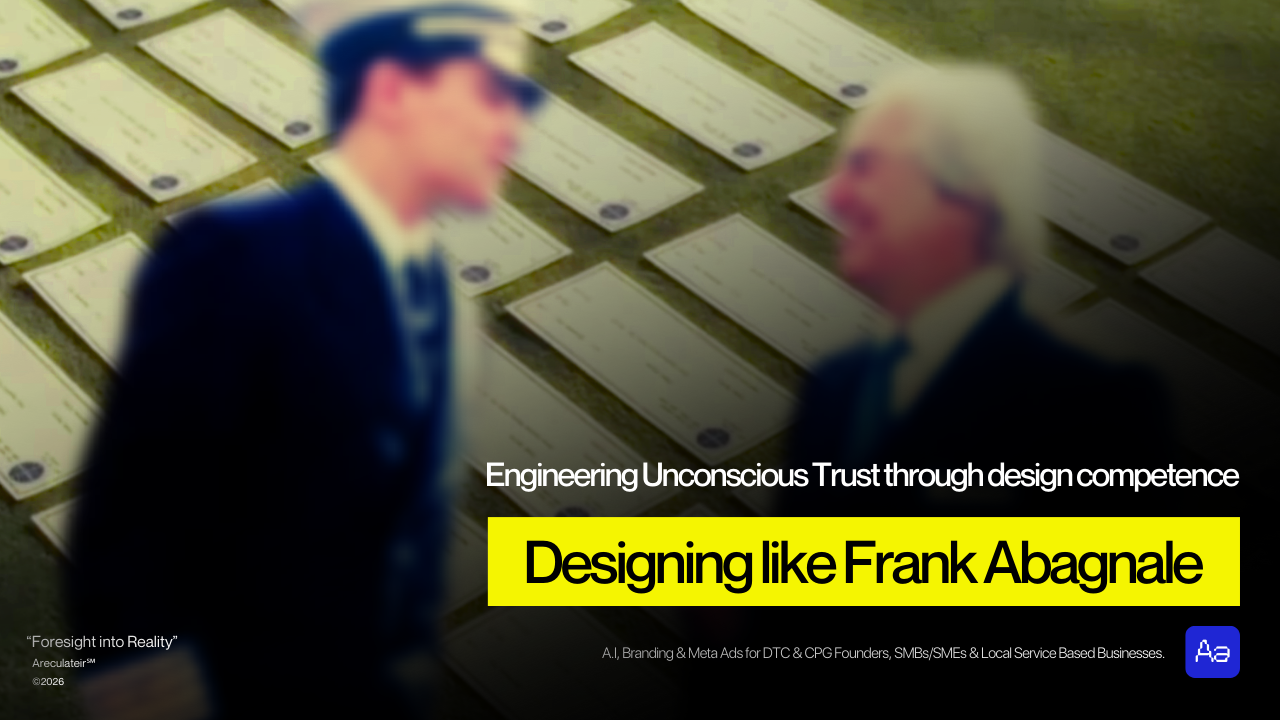
Designing like Frank Abagnale

Engineering unconscious trust through design competence.

Designing like Frank Abagnale — Engineering unconscious trust through design competence

Precision, Consistency, Credibility Engineering. Trust is not persuaded — it is inferred. Abagnale succeeded by understanding that people don’t verify what feels structurally correct. Titles, typography, documents, language, and sequencing aligned so cleanly that doubt never activated. In design, the same principle applies: when systems are coherent, hierarchy is disciplined, and execution is exact, users stop evaluating and start complying. Competence becomes the interface.

Designing for Cognitive Shortcuts. Human trust operates on heuristics. Abagnale exploited the fact that people rely on visual order, familiar structures, and confident signaling to decide what is legitimate. Interfaces work the same way. When design elements align with expectation — correct spacing, formal hierarchy, restrained language, and procedural flow — users assume authority without conscious scrutiny. The goal isn’t deception; it’s eliminating friction by making correctness obvious.

Authority Without Deception. Abagnale’s insight wasn’t fraud — it was pattern recognition. People trust what appears internally consistent, procedurally sound, and confidently executed. Good design applies this insight ethically: not to mislead, but to remove uncertainty. When every element reinforces legitimacy — visual systems, copy tone, interaction timing — trust becomes automatic. The best interfaces don’t convince users; they make doubt unnecessary.

Areculateir display picture
Want a new site for FREE?
Join the Waitlist